Creating a proper GST invoice in India is an essential requirement of running a GST-registered business. Whether you are a freelancer, retailer, manufacturer, wholesaler, service provider, e-commerce seller, consultant, agency, or growing company, your invoice needs to contain the right information so that transactions are properly documented.
A well-prepared GST invoice does more than show the amount payable. It records supplier and customer details, taxable values, applicable GST splits, HSN/SAC classifications, place of supply, consecutive invoice numbers, and other statutory fields required under GST rules.
This complete guide explains the GST invoice format in India, mandatory details under Rule 46, CGST and SGST vs IGST, HSN and SAC codes, invoice numbering best practices, GST bill formats, e-invoicing distinctions, common mistakes, and how to create professional GST invoices online.
Looking for a faster way to create compliant GST invoices?
Use our free online tool to calculate CGST, SGST, IGST automatically with instant PDF download.
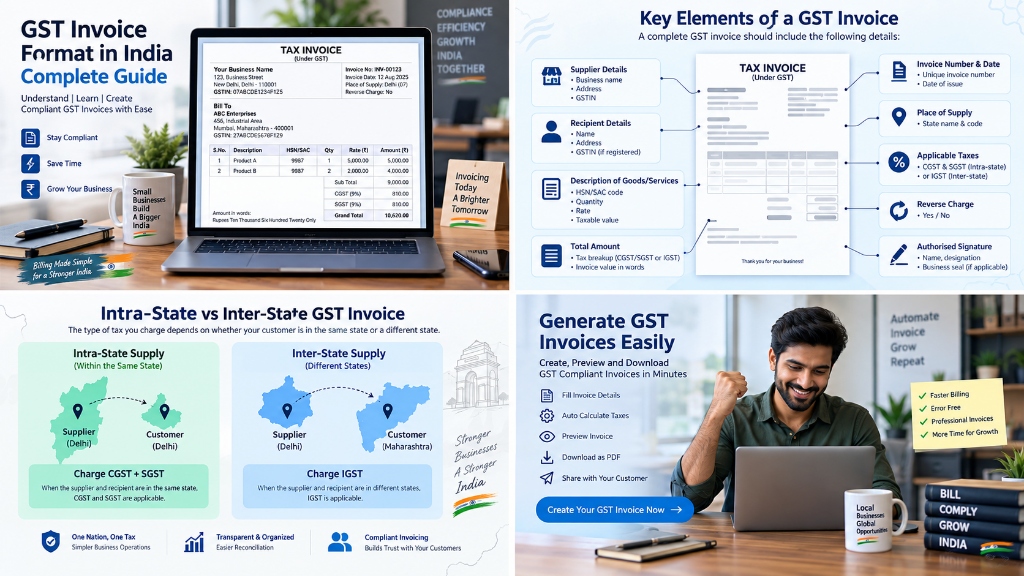
Comprehensive Visual Guide: Key Elements of a GST Tax Invoice, Intra-State vs Inter-State Tax Rules & Digital Generation
What Is a GST Invoice?
A GST invoice (or tax invoice) is an official commercial document issued by a GST-registered business to a recipient when supplying taxable goods or services.
Under India's GST framework, a tax invoice contains vital legal information about the transaction, including the supplier's 15-character GSTIN, unique consecutive invoice number, date of issue, recipient information, description of goods or services, HSN/SAC codes, taxable values, applicable tax rates, and tax breakups.
A GST invoice is crucial because it helps:
GST Invoice Format in India: Core Structure
Under Rule 46 of the CGST Rules, a standard GST tax invoice contains the following 18 essential sections:
GST Invoice Format Example
Here is an illustrative example of an inter-state B2B tax invoice (Supplier in Delhi, Customer in Haryana):
123 Business Road, New Delhi – 110001
GSTIN: 07ABCDE1234F1Z5
Invoice No: INV-2026-001
Date: 12 September 2026
Place of Supply: Delhi (07)
Bill To (Recipient):
XYZ Enterprises
456 Market Road, Gurugram, Haryana – 122001
GSTIN: 06XYZAB1234C1Z7
Amount in Words: Eighty-Two Thousand Six Hundred Rupees Only
For ABC Technologies Pvt. Ltd. — Authorized Signatory
Mandatory Particulars Under GST Law (Rule 46)
Understanding the mandatory fields is critical to avoiding input credit rejections and compliance penalties:
1. Supplier Details & 15-Digit GSTIN
The supplier's legal/trade name, registered address, and valid 15-digit GSTIN (Goods and Services Tax Identification Number, e.g. 07ABCDE1234F1Z5). The first two digits represent the State code.
2. Unique Consecutive Invoice Number (Max 16 Characters)
Under Rule 46, every invoice must have a consecutive serial number unique for the financial year (April 1 to March 31). It cannot exceed 16 characters and can include letters, numbers, hyphens (-), and slashes (/), e.g., INV/26-27/001.
3. Place of Supply
Crucial for determining whether the transaction is an intra-state supply (CGST + SGST) or an inter-state supply (IGST). For inter-state supplies, mentioning the State Name and State Code of the delivery address is mandatory.
4. HSN Code (Goods) or SAC Code (Services)
HSN (Harmonized System of Nomenclature) applies to physical products, while SAC (Service Accounting Code) applies to services. B2B invoices generally require 4-digit or 6-digit HSN/SAC codes depending on annual turnover. Never guess a classification code.
5. Taxable Value & Tax Rate Breakup
The invoice must distinctly show the taxable value (gross amount minus discounts), followed by separate columns/rows for the applicable GST rate and tax amounts (CGST, SGST, or IGST).
Intra-State vs Inter-State GST Invoices
One of the most important concepts in Indian taxation is understanding whether a sale is intra-state or inter-state:
When the supplier and the customer are located in the same State (e.g., Delhi supplier selling to a Delhi buyer).
Taxable Value: ₹50,000 (18% GST)
• CGST @ 9%: ₹4,500
• SGST @ 9%: ₹4,500
Total: ₹59,000
When the supplier and customer are in different States (e.g., Delhi supplier selling to a Maharashtra buyer).
Taxable Value: ₹50,000 (18% GST)
• IGST @ 18%: ₹9,000
• CGST / SGST: ₹0
Total: ₹59,000
GST Tax Invoice vs Bill of Supply
Businesses often confuse a Tax Invoice with a Bill of Supply:
| Feature | GST Tax Invoice | Bill of Supply |
|---|---|---|
| Used for taxable supplies | Yes | Generally No |
| GST charged separately | Yes (CGST/SGST/IGST) | No tax collected |
| Input Tax Credit (ITC) claimable | Yes (by eligible recipient) | No |
| Used by Composition Taxpayers | No | Yes |
| Used for 100% exempt supplies | No | Yes |
What Is an E-Invoice? (PDF Invoice ≠ E-Invoice)
A common misconception is thinking that exporting a PDF invoice electronically makes it an "e-invoice".
Crucial Distinction:
An e-Invoice under GST requires businesses crossing specific annual aggregate turnover thresholds (currently ₹5 crore) to upload transaction payloads (JSON schema) to the government Invoice Registration Portal (IRP). The IRP validates the data and generates a unique 64-character Invoice Reference Number (IRN) and a digitally signed QR code.
A PDF invoice generated from our tool is a professional commercial invoice suitable for small businesses, service providers, and freelancers who do not fall under mandatory IRP e-invoicing.